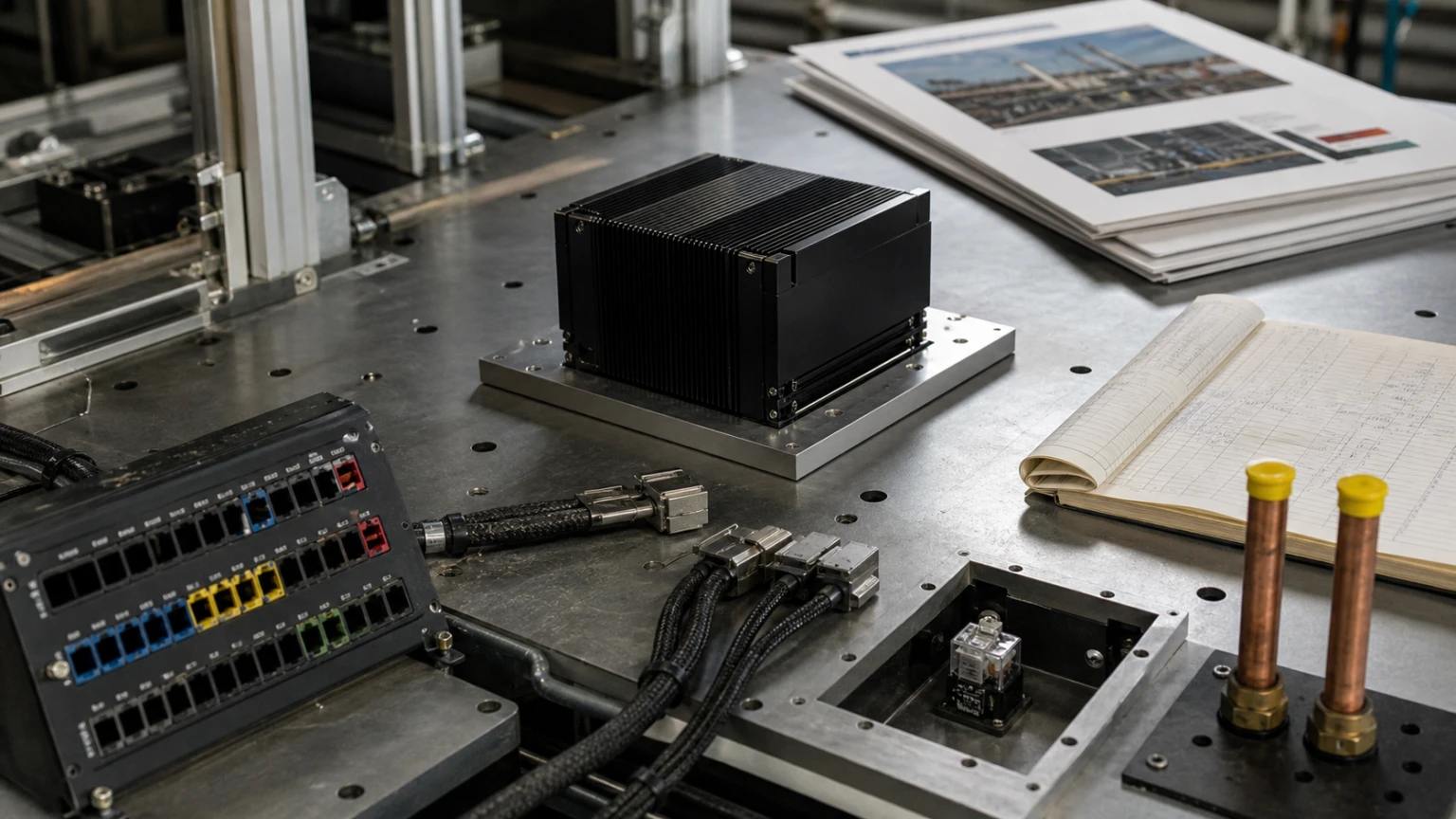
An AI demo can look useful long before anyone has agreed on a measure of value, a production owner or an acceptable failure mode. That is why pilots stall.
A pilot fails long before the model does
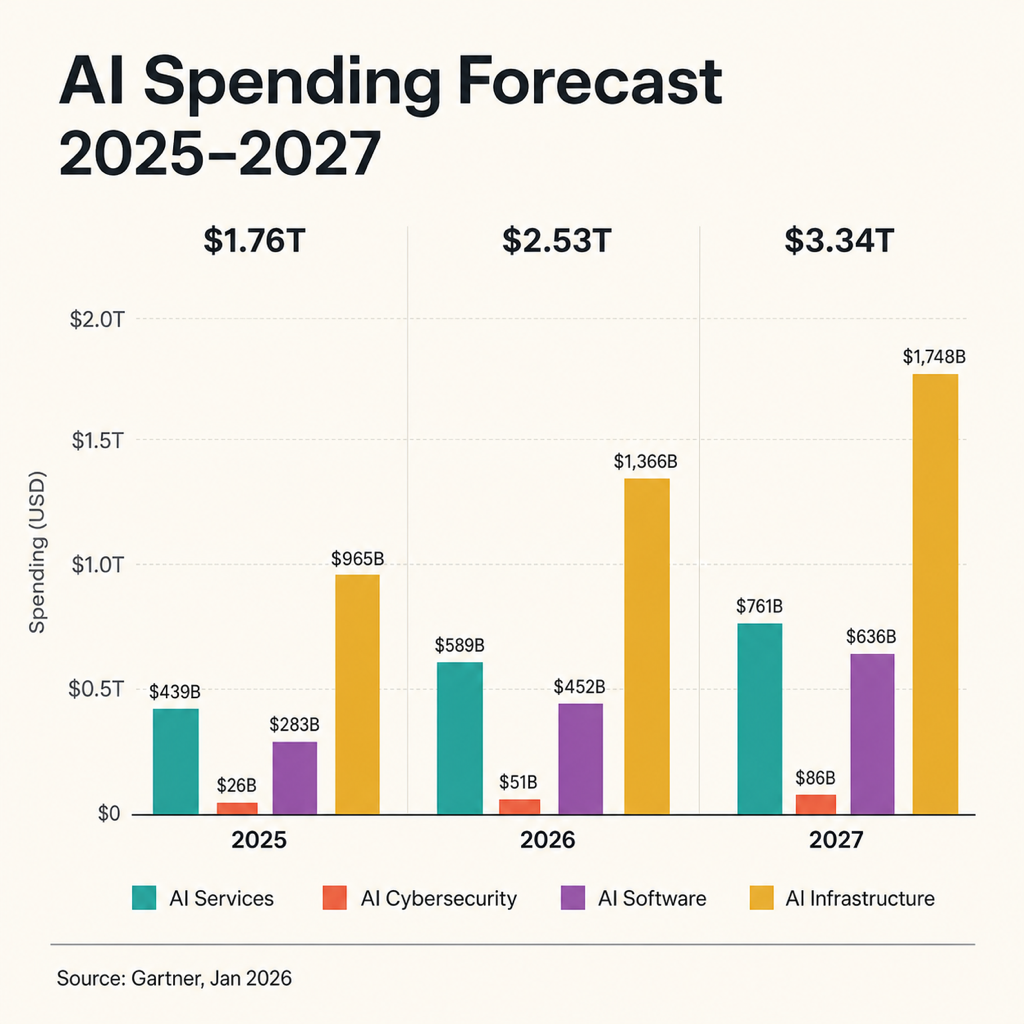
After nearly a decade building data platforms in regulated industries, I keep seeing the same sequence: budget and technical activity arrive before the team defines the work that must improve. Gartner forecasts $2.52 trillion in worldwide AI spending in 2026. That figure measures expected spend, not useful work.
The often-cited MIT NANDA result says 95% of generative AI pilots fail to deliver significant ROI. It is a useful warning, not a universal failure rate. The finding concerns reported significant return on investment in that research context; it does not show that 95% of every AI pilot fails for one common technical reason.
Four mechanisms explain many stalled pilots: undefined value, production constraints bypassed, no operating owner, and a demo measured instead of the work. Architecture, security, cost and skills are not side topics. They expose those failures.
Failure 1: value is a slogan, not a unit of work
A pilot starts in trouble when its goal is "use AI" or "improve productivity." Those are ambitions, not outcomes. Before selecting a model, name one recurring decision or task, its current baseline, the accountable business owner and the cost of being wrong. The unit might be a case resolved correctly, a document reviewed within a service level, or a handoff completed without rework. It must be observable in normal work.
Architecture comes after that promise. A lakehouse combines open storage with warehouse-style management; a data mesh assigns data products to domain teams. Neither repairs a vague use case. They serve a task that needs reliable data, clear ownership and traceable answers.
Retrieval-augmented generation (RAG) supplies documents at answer time. An agentic system may then choose sources and tools across several steps. The freer the path, the tighter the task, authorised sources and completion tests must be. Otherwise the demo is only more elaborate.
| Operating layer | Question to answer | Evidence of progress | Accountable owner |
|---|---|---|---|
| Business outcome | Which repeated task changes? | Baseline and success threshold | Process owner |
| Data and model | What evidence may the system use? | Traceable, evaluated outputs | Data and technical owner |
| Operation | Who handles failure and change? | Runbook, service level, escalation | Named service owner |
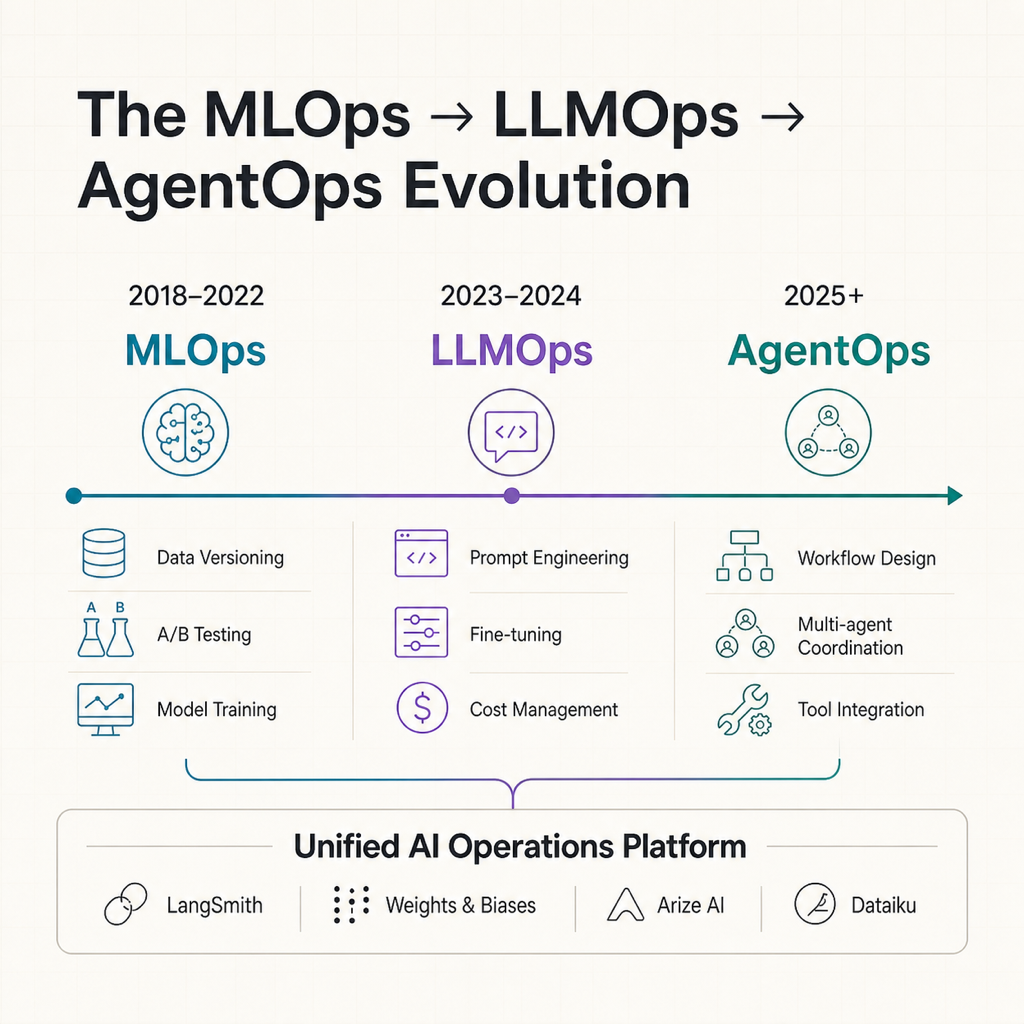
Labels such as MLOps (operating machine-learning systems), LLMOps (operating large language model applications) and AgentOps (operating systems that can choose tools and steps) describe useful operating concerns. They are not maturity badges. A team that cannot state its value unit and owner will not be rescued by adding another platform.
Failure 2: the prototype avoids production constraints
Token cost varies with prompt length, context window, retries and the number of steps an agent takes. But a prototype often hides more: identity, source quality, latency targets, incidents and difficult cases. All of it returns when real users depend on the system.
| What the demo hides | What production needs | Failure it exposes | First operating check |
|---|---|---|---|
| Small, clean inputs | Representative data and permissions | Answers cannot be trusted | Test on normal and adverse cases |
| One happy-path prompt | Retries, fallbacks and limits | Cost and latency drift | Set a budget per completed task |
| Human watching the screen | Logs, alerts and support | Failures are invisible | Write an escalation path |
| No external action | Least-privilege tool access | Unsafe changes or disclosure | Review every allowed action |
| Short experiment | Change control and evaluation | Quality decays unnoticed | Re-test after model or data changes |
This is why infrastructure decisions should be downstream of demand, not a reaction to a forecast. Cloud APIs can be a sensible way to test a bounded workload. Self-hosted or dedicated capacity may make sense at sustained volume, but only after the team can measure completed work, reliability and total operating cost. A headline saving from a simulation is not a business case for every workload.
GenAI FinOps applies cost accountability to generative AI. Keep it practical: record cost, latency and quality against the task that matters. Right-size models and prompts, cap expensive paths, and make a person responsible for exceptions. FinOps is not a separate cost report; it is a guardrail against shipping an economics problem disguised as a pilot.
Failure 3: nobody owns the system once it can act
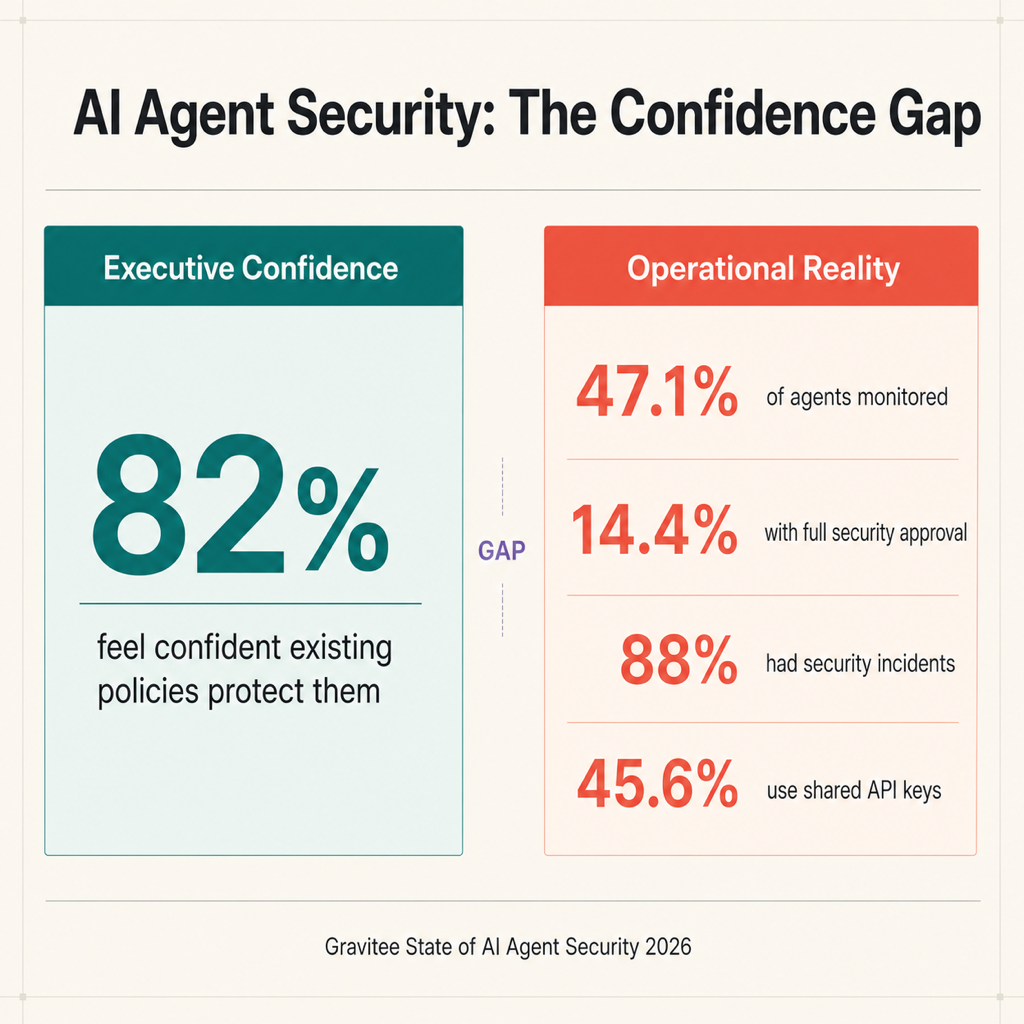
The important question is not whether an agent is impressive. It is who owns its behaviour at 2 AM, who can change its permissions, and who investigates a harmful action. The cited Gravitee survey of executives reported that 47.1% of AI agents were actively monitored while 82% of executives felt confident in their policies. A vendor survey is not an audit of the market, but the gap is an operational warning.
| Control gap reported | Survey result | Why it matters and the first response |
|---|---|---|
| Active monitoring | 47.1% | Failures may have no trail. Log requests, tools and outcomes. |
| Full security approval | 14.4% | Controls may lag deployment. Set a release gate. |
| Independent identities | 21.9% | Actions cannot be attributed cleanly. Give each agent a scoped identity. |
| Shared API keys | 45.6% | Privilege is difficult to revoke. Use short-lived, least-privilege access. |
| Confirmed or suspected incidents | 88% | The category is broad and self-reported. Treat incidents as learning inputs, not proof of breach. |
An agent that retrieves data, calls tools or creates records is a service making decisions. Give it a scoped identity, minimal permissions, an audit trail and a kill switch. Those controls exist first to explain an action, then to stop one.
Frameworks and vendor features can help, but they do not supply an owner. Whether the system uses a managed model, a lakehouse, RAG or an agent framework, someone must be accountable for its data, behaviour, cost and operational decisions. Without that role, the pilot has no credible route to production.
Failure 4: the demo is measured, not the work
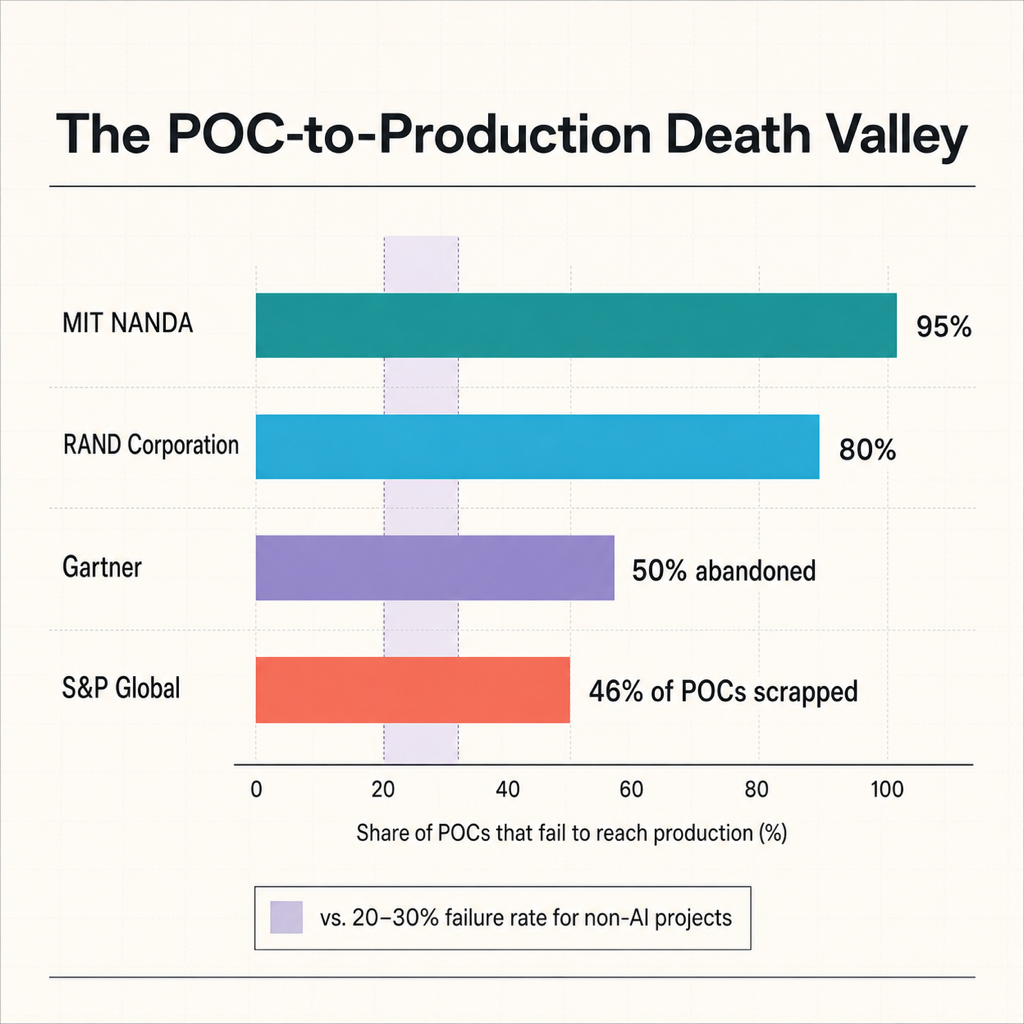
A proof of concept can prove that a model responds, retrieves a document or completes a happy path. It does not prove that a real process improved. The published failure figures below are not interchangeable: they use different populations, definitions and timeframes. Their common lesson is narrower and more useful: a demo without a continuing success measure is easy to celebrate and hard to operate.
| Source | Reported result | What the result does not establish |
|---|---|---|
| MIT NANDA | 95% did not deliver significant ROI | A universal pilot-failure rate |
| RAND Corporation | >80% of AI projects fail | One cause shared by all projects |
| Gartner | At least 50% abandoned after POC | That abandonment is solely technical |
| S&P Global | 42% abandoned most initiatives | That every initiative had the same goal |
For each pilot, define a production-shaped scorecard before the demo: correct completion, exception rate, cycle time, human rework, cost per completed task and any safety or compliance threshold. Then compare it with the current process. If the system cannot meet the scorecard on representative work, stopping it is a decision, not a failure of enthusiasm.
The four failures meet here: without value, no scorecard; without real constraints, cost and failure stay hidden; without an owner, nobody operates the service. A polished demo can survive all three until the first real dependency.
Skills matter after the operating work is named
Teams need people who can evaluate model output, work with data controls, design safe integrations and run a service. Training alone will not define the use case or assign its owner.
Train against the work you intend to run: how to judge an output, when to escalate, how to trace a decision, how to test a prompt or model change before release, and how to interpret the scorecard. Use those tasks to identify what developers and operators need to practise.
Operate the next pilot like a service
Do not start with a platform roadmap. Start with one costly, repeated piece of work and design the smallest service that can improve it safely. The next steps make the four failure mechanisms visible early, when stopping or changing course is cheap.
Immediate: Name the process owner, baseline, success threshold and stop condition. Test on representative cases, including exceptions. Record quality, cost and time per completed task, not just prompts or demonstrations.
Before wider use: Add identity, least-privilege access, logs, evaluation, budget limits and an escalation path. Decide who owns data, model changes, incidents and user support. If those answers are absent, the pilot is not ready for production.
At portfolio level: Fund the operating capability around the few workloads that meet their scorecards. Train people against those workflows. Choose cloud, managed and dedicated infrastructure from measured demand, reliability and total cost, not from a generic AI architecture diagram.
References
- Gartner. (2026). "AI Spending Will Total $2.5 Trillion in 2026."
- Estrada, S. (2025). "MIT: 95% of GenAI pilots failing." Fortune.
- Ryseff, J., De Bruhl, B., & Newberry, S. J. (2024). "The Root Causes of Failure for Artificial Intelligence Projects and How They Can Succeed." RAND Corporation.
- Gravitee. (2026). "State of AI Agent Security 2026."
- S&P Global Market Intelligence. (2025). "Generative AI experiences rapid adoption, but with mixed outcomes."
- Deloitte. (2026). "AI tokens: spend dynamics."
- Chandrasekaran. (2026). "Why GenAI Projects Fail." Gartner.
- Deloitte. (2025). Survey of measurable AI value reported by global finance leaders.