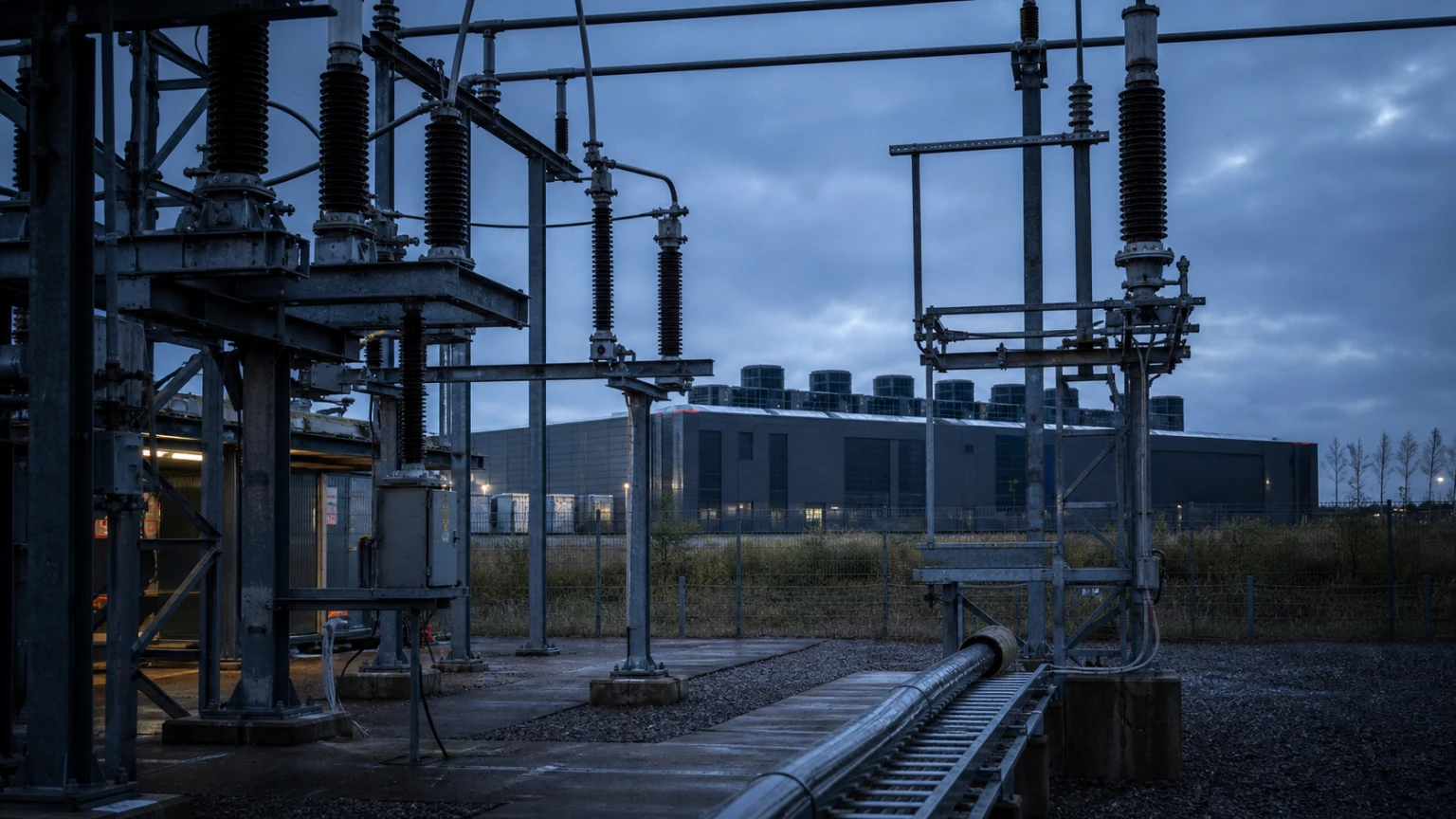
A GPU order is not usable AI capacity. The cluster becomes a concentrated electrical load; that load joins a grid queue; the connection date decides where and when Europe can run sovereign workloads.
The GPU plan ends at a local substation
The International Energy Agency estimated that EU data centres used about 70 terawatt-hours of electricity in 2024. The annual total hides the engineering problem. A new data centre adds one large load at one point on the network, often near a city where land, substations, and transmission capacity are already constrained.
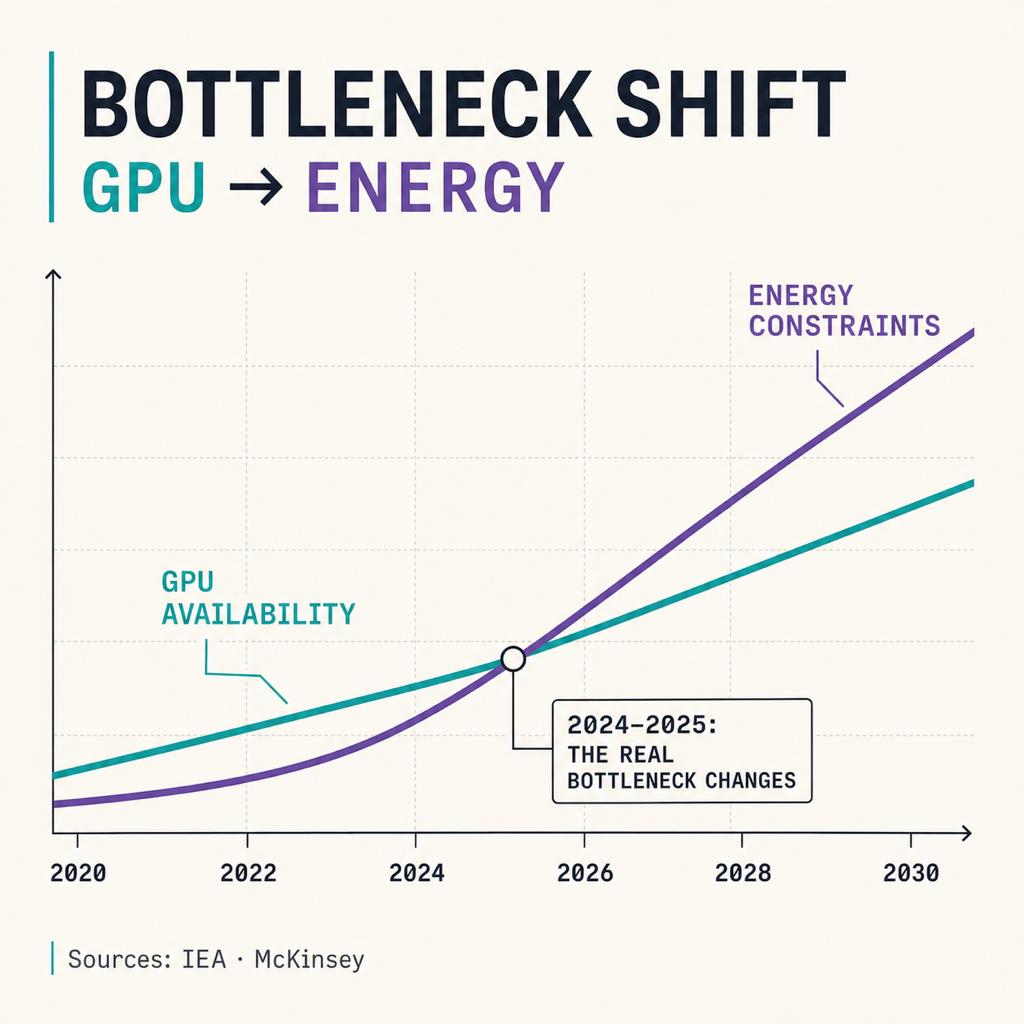
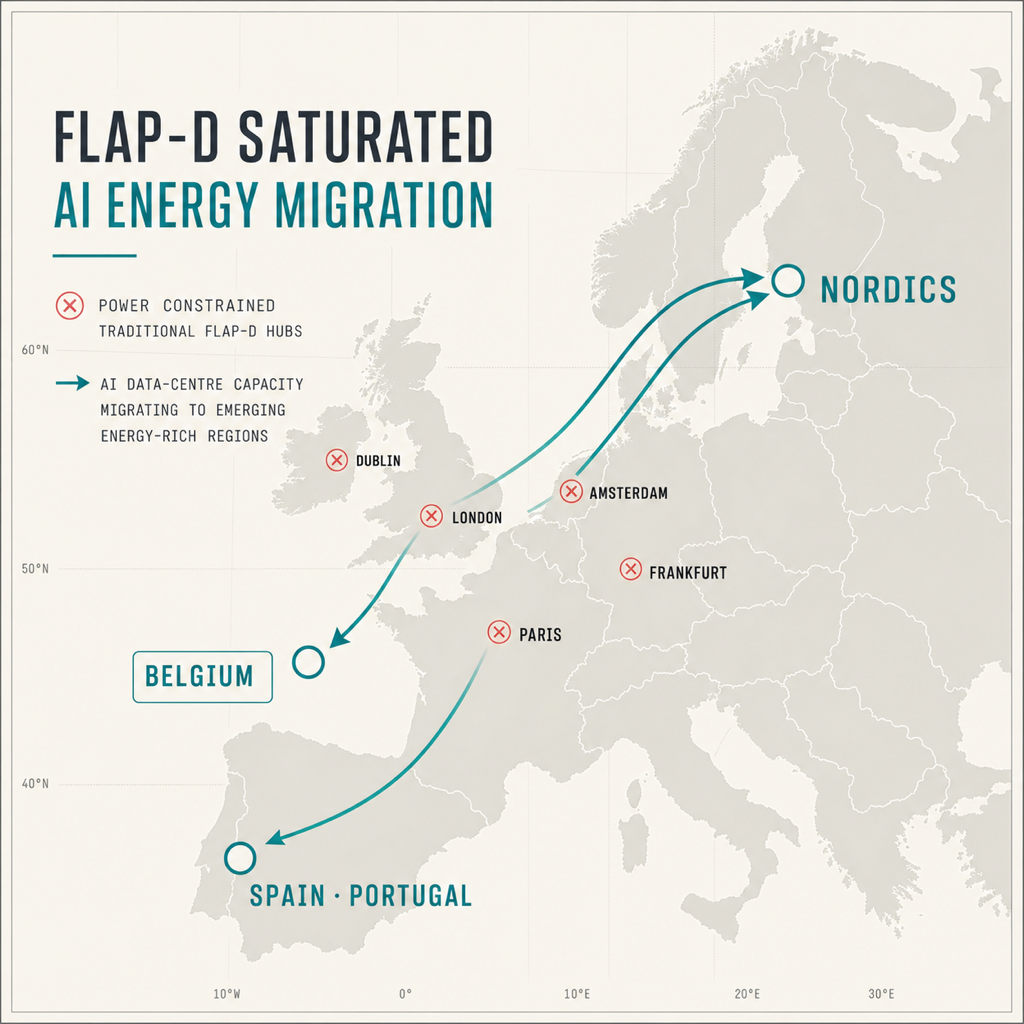
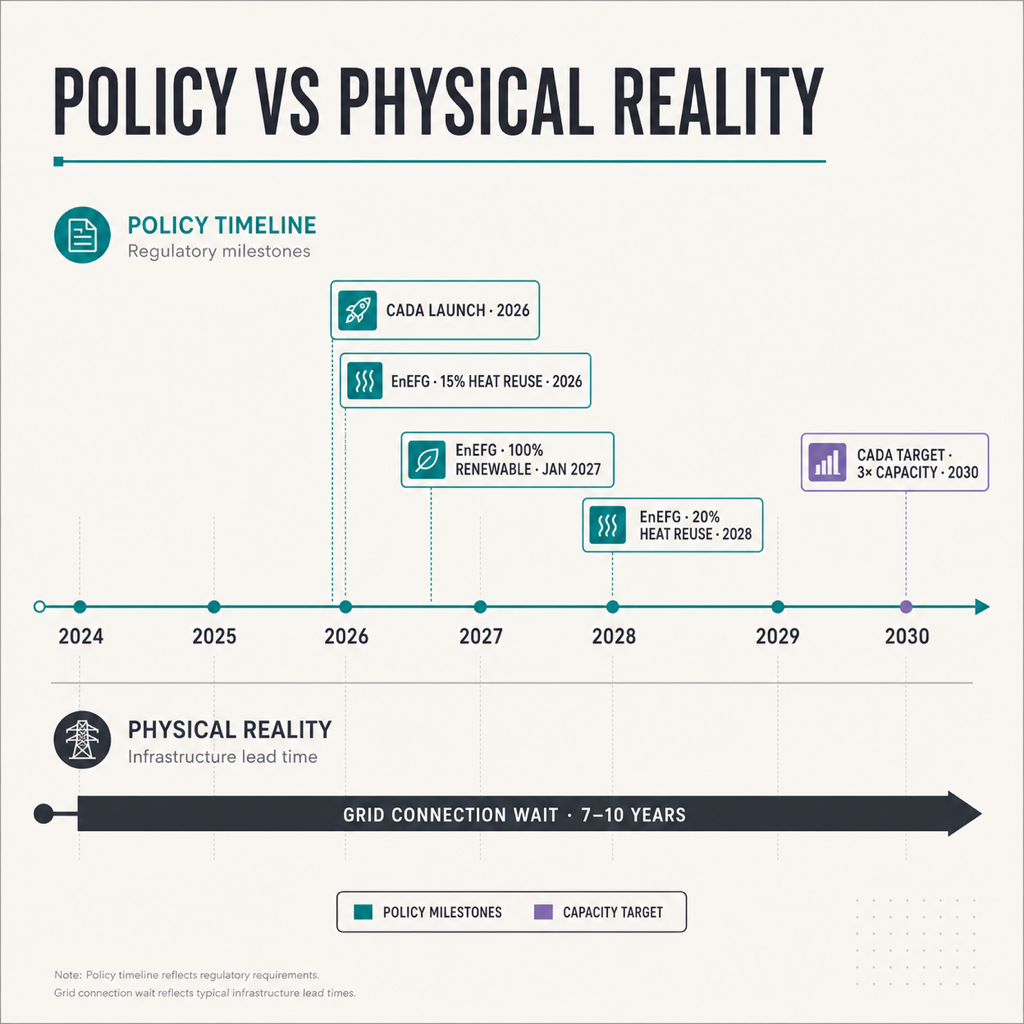
A data centre can take one to two years to build; an EU grid connection can take two to ten. In FLAP-D—Frankfurt, London, Amsterdam, Paris, and Dublin—the IEA reports average queues of seven to ten years. Dublin and Amsterdam have already paused projects because their grids could not absorb more large loads.
A better PUE can still mean a larger connection
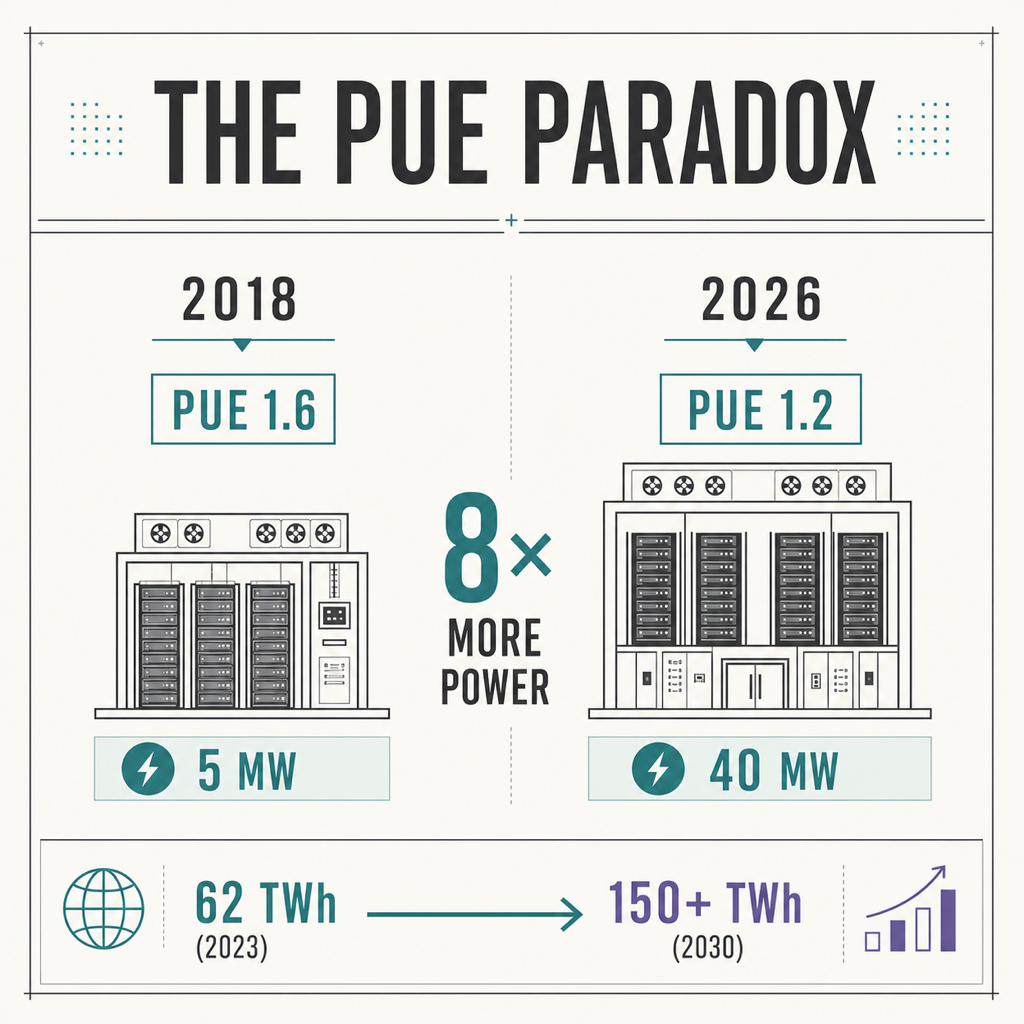
Power Usage Effectiveness (PUE) divides total facility electricity by IT electricity. At 1.2, a site draws 1.2 units for every unit delivered to servers; cooling, power conversion, and other overhead consume the remaining 0.2. PUE is an efficiency ratio, not a demand cap.
A larger AI cluster can improve its PUE and still require a much bigger grid connection because the server load grew faster than the overhead fell. This is the key distinction between relative efficiency and absolute electricity use. The IEA expects global data-centre electricity consumption to double by 2030 and electricity use from AI-focused facilities to triple, while also warning that physical bottlenecks will slow some projects.
The connection date changes the architecture
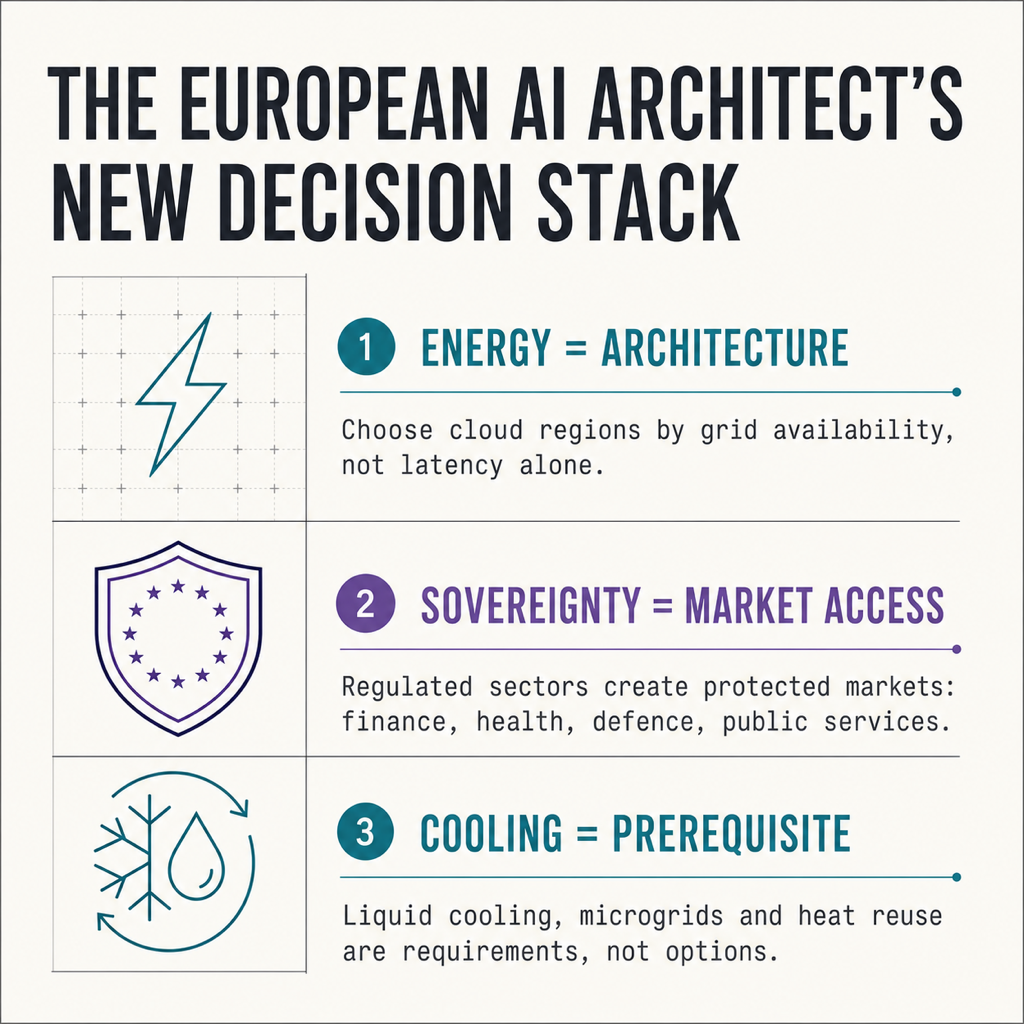
If a region cannot supply power on the required date, the architecture changes. The requested cloud accelerator may be unavailable. Colocation may wait for a substation. A private cluster may need a smaller first phase, a curtailable connection, or another country. Energy has become a workload-placement constraint.
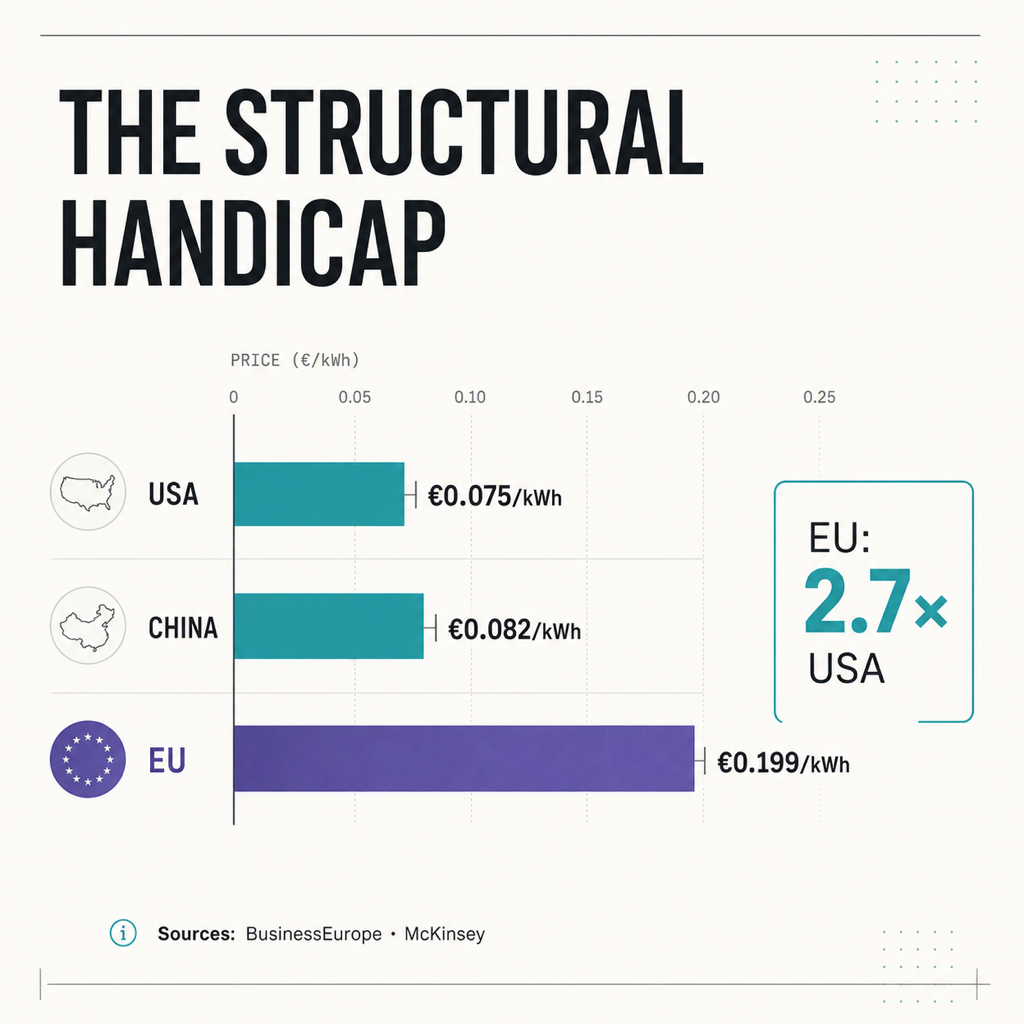
Price still matters, but a cheap megawatt that is unavailable for seven years is not an input to today's business case. Platform leaders need the connection date, firm versus interruptible capacity, expected curtailment, expansion rights, and power-price exposure beside the usual latency, security, and data-residency requirements.
Sovereignty is a recovery test, not a provider label
Debates about European AI sovereignty usually stop at data, chips, and cloud providers. Add power. A team may control its data and software yet remain unable to connect, renew a power contract, expand capacity, or recover in another region.
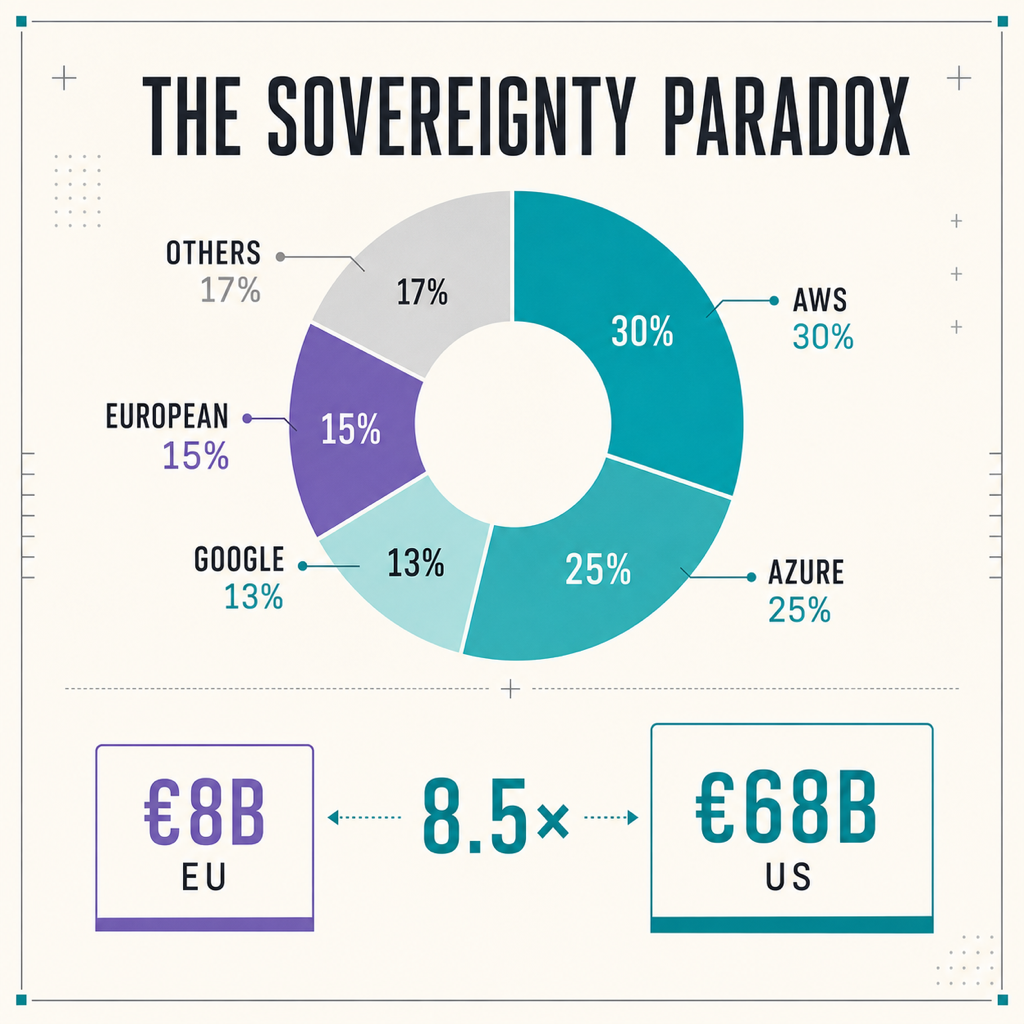
Provider concentration still matters. A European Parliament briefing reported that three U.S.-based companies account for about 65% of the EU cloud-services market. But replacing a logo does not remove dependencies on accelerators, grid equipment, electricity markets, software supply chains, or specialist operators. The practical question is which dependencies are visible, governed, and replaceable within an acceptable recovery time.
| Decision layer | Question to answer | Failure mode |
|---|---|---|
| Compute supply | Can equivalent accelerators be sourced and supported? | A single hardware roadmap controls delivery |
| Power and grid | Is firm capacity available on the deployment date? | Hardware waits for a connection or is curtailed |
| Cloud control | Who operates the service and which laws apply? | A legal or commercial event interrupts access |
| Data and models | Can state, lineage, and model artifacts move? | Exit exists on paper but migration is impractical |
| Operations | Can another team restore the service? | Sovereignty depends on one vendor's people and tooling |
“Energy rich” is not a deployment plan
The IEA expects new European data-centre hubs in places including Spain and Finland, while much of the announced pipeline remains in established hubs. Moving from “congested” to “energy rich” is not enough. Check network capacity, fibre routes, climate risk, permits, skills, and electricity mix for the actual site.
Policy is moving too. The European Commission proposed the Cloud and AI Development Act (CADA) on June 3, 2026; it is still in the EU legislative process. The proposal aims to triple EU data-centre capacity over five to seven years and encourage a more balanced geographic spread. Germany's Energy Efficiency Act (EnEfG) already sets PUE, renewable-electricity accounting, and energy-reuse requirements for data centres, with thresholds based on commissioning date and defined exceptions. These measures can shape projects, but they do not create grid capacity on their own.
Separate policy ambition from deliverable capacity
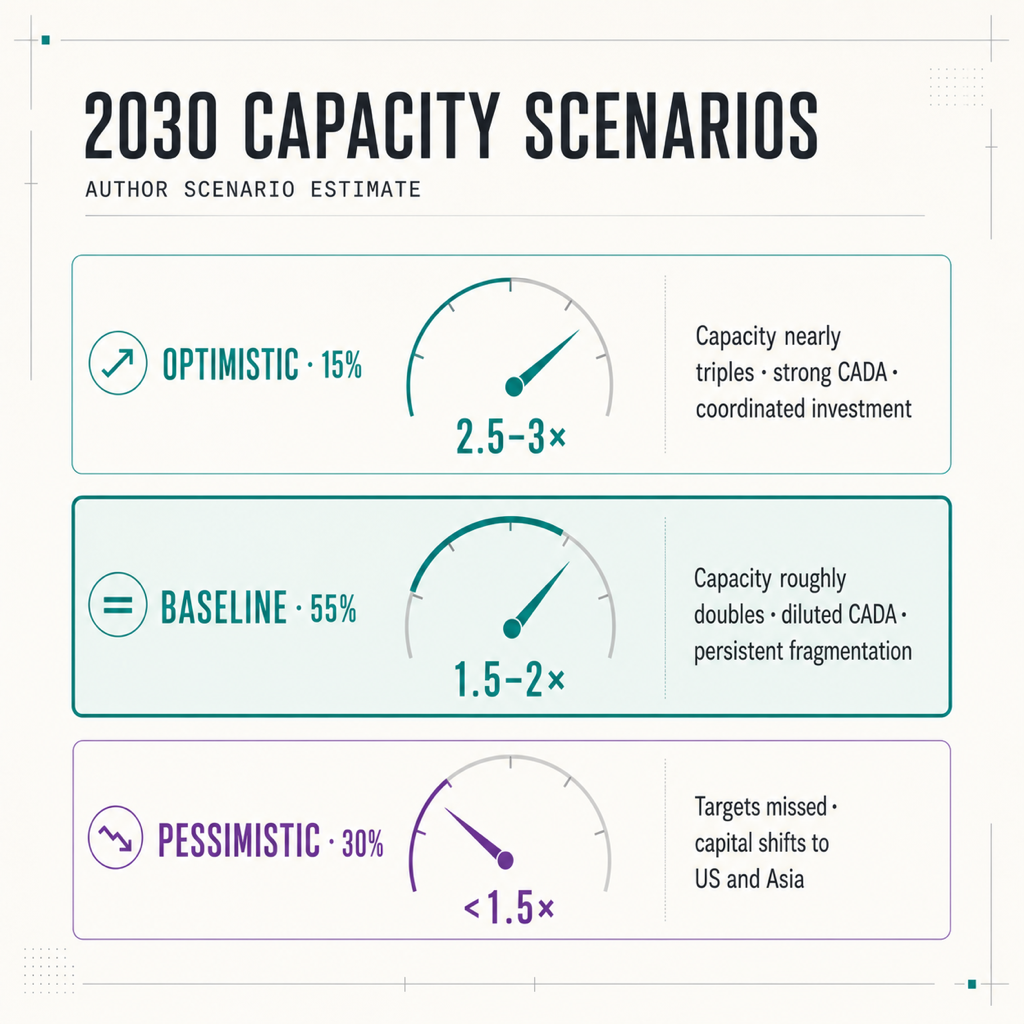
The Commission's target is not a forecast. Neither is the project pipeline. Announced facilities may be delayed, resized, or cancelled, and completed buildings take time to fill. Counting every announced megawatt as live capacity overstates delivery.
The IEA's current-policy modelling projects European installed data-centre capacity to grow by about 70% between 2024 and 2030. That is substantial, but well below a tripling. The gap is not proof that CADA will fail. It is a planning baseline that reflects grid congestion and other local constraints before the proposal's final form and implementation are known.
Permitting reform can shorten administrative work. Queue reform can prioritize projects that are ready to build. Flexible connections, storage, and better siting can use the network more effectively. None of these measures eliminates the causal chain: more AI demand creates more local load, and local infrastructure determines when and where that load can run.
Put the connection evidence beside the GPU plan
Before selecting a region or signing a long-term capacity commitment, require five checks:
- Ask for capacity evidence. Record the grid-connection date, firm capacity, curtailment terms, expansion rights, and the assumptions behind each answer.
- Model absolute load. Keep PUE in the design, but forecast total IT demand, cooling, utilization, ramp-up, and peak import capacity in megawatts and megawatt-hours.
- Place workloads by constraint. Separate latency-sensitive inference, batch training, regulated data, and disaster recovery. They do not all need the same region or provider.
- Test sovereignty as recovery. Measure whether data, model artifacts, identities, and operations can move to an acceptable alternative within the required recovery time.
- Treat on-site power as a project, not a shortcut. A microgrid is a local system that manages generation, storage, and load and may be able to operate independently. It still needs engineering, permits, fuel or generation supply, interconnection rules, and an operating model.
If the power date is later than the product date, the infrastructure strategy is not finished.
References
- International Energy Agency. "Overcoming energy constraints is key to delivering on Europe's data centre goals." November 2025.
- International Energy Agency. "Data centre electricity use surged in 2025, even with tightening bottlenecks driving a scramble for solutions." April 2026.
- European Commission. "Energy performance of data centres." Updated 2026.
- European Parliamentary Research Service. "Cloud and AI development act." PE 779.251, December 2025.
- European Parliament Legislative Observatory. "Cloud and AI Development Act, 2026/0138(COD)." June 2026.
- European Commission. "Strengthening Europe's tech sovereignty." June 3, 2026.
- European Commission. Delegated Regulation (EU) 2024/1364 on a common Union rating scheme for data centres.
- Federal Republic of Germany. Energy Efficiency Act (EnEfG), Section 11: Climate-neutral data centres.