
Maven Smart System (MSS) compresses the path from sensor observation to proposed action. Its architecture explains the speed. The public record does not show that review quality, accountability, or judgment improved at the same rate.
Start with the asterisk beside “under one minute”
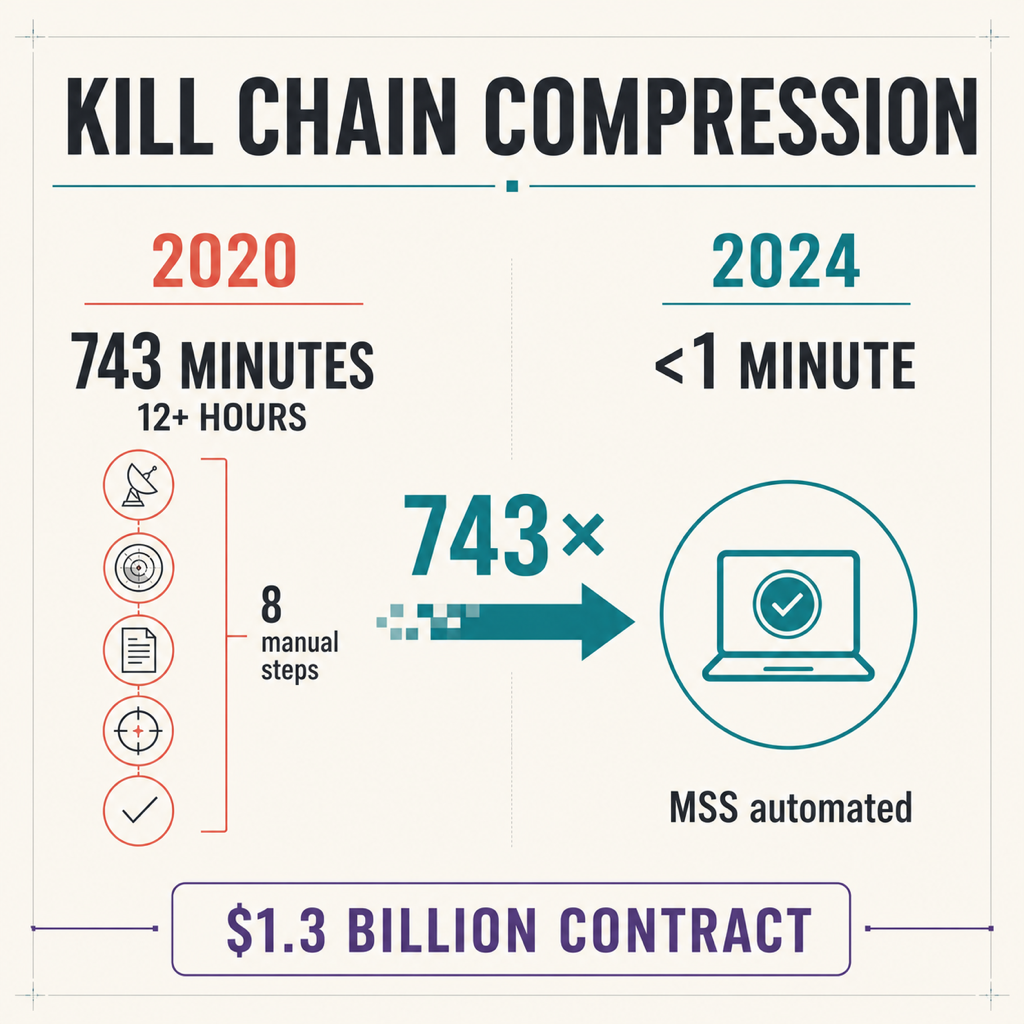
Army Times reported that a digital target pass in the Scarlet Dragon exercise series took 743 minutes in 2020. In 2024, an XVIII Airborne Corps officer said a later iteration took under one minute. The workflow became much faster. But this was not a controlled before-and-after study: the exercises, software, teams, and operating conditions had changed.
A separate 2025 paper hosted by the U.S. Department of Defense reports a related Project Maven exercise moving from 724 to 20 minutes. Both accounts suggest fewer handoffs and faster routing. Because their baselines differ, the sub-minute figure remains reported exercise performance, not a universal operational service level.
So inspect the workflow, not the headline: which steps moved into software, which judgments stayed with people, and whether review capacity kept pace with throughput.
Part A: Follow one observation, not the product diagram
A satellite image covers a large area. A computer-vision model marks a possible vehicle and adds a location, time, and confidence score. That output is an observation, not a verified target. Public U.S. Army material says Maven publishes detections from electro-optical or radar imagery into a shared layer reviewed by targeting officers and geospatial-intelligence analysts.
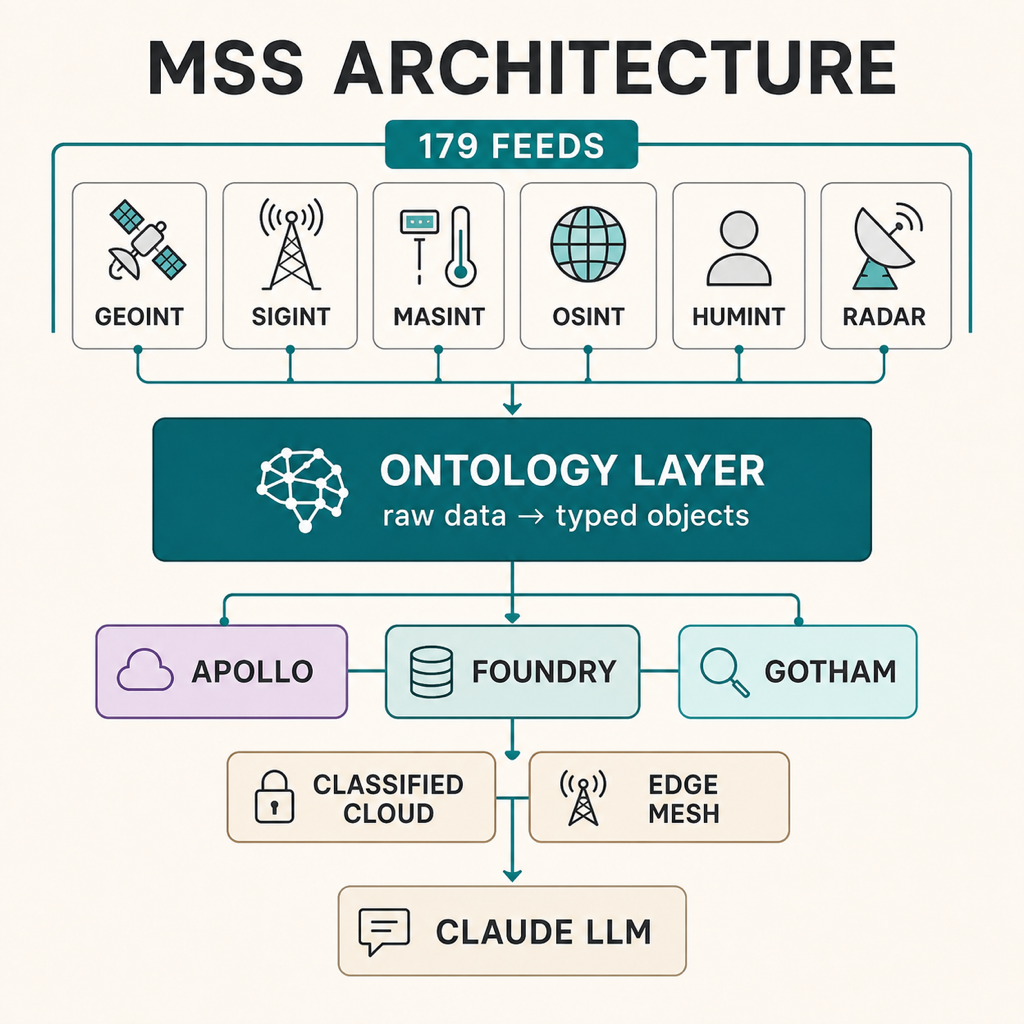
Palantir calls the shared object model an ontology: a governed map of known entities and their relationships. The platform can attach an image, a spreadsheet row, and a message to one object with common identifiers and provenance. That cuts reconciliation work. It does not resolve a contradiction simply by placing both observations on the same screen.
Palantir's public documentation describes Apollo as the software deployment and management layer for products running across multiple environments. Public sources do not disclose enough detail to reconstruct the exact classified MSS topology. Claims about specific security impact levels, disconnected field configurations, or third-party edge components should therefore be treated as vendor statements unless a government source confirms the MSS implementation.
| Step | What software contributes | What still requires judgment |
|---|---|---|
| Sensor observation | Image, video, or another time-stamped input | Is the source current, complete, and reliable? |
| Model detection | Candidate object, location, and confidence | Does the detection match the underlying evidence? |
| Shared object | Links observations and context under one identity | Are sources conflicting, stale, or duplicated? |
| Analyst view | Presents the object in a common operating picture | Does it meet approved vetting and validation criteria? |
| Proposed action | Routes a reviewed item into the next workflow | Is the proposed action lawful, necessary, and appropriate? |
| Human authorization | Records approval, rejection, and user identity | Who is accountable, and was there time to disagree? |
Shared context removes handoffs, not uncertainty
Geospatial intelligence (GEOINT) ties information to a place: a satellite image, for example, or a mapped observation. Sensors capture different slices of reality at different times and confidence levels. Fusion aligns them for comparison.
A second image may support the possible-vehicle detection, contradict it, or be too old to help. Software can surface those relationships quickly. An analyst still has to decide whether the sources refer to the same object and satisfy the current rules. Data agreement is not ground truth.
Public Army sources support a narrow description: MSS processes imagery and full-motion video, publishes machine detections into a shared view, and supports targeting, situational-awareness, and logistics workflows. They do not establish automatic identification of a specific air-defence system or replacement of an entire operational process.
An LLM adds a new review surface
NATO's acquisition announcement says MSS NATO can support applications ranging from machine learning to large language models (LLMs). That describes capability, not use. The announcement does not name a model used in an operation, its data access, or whether its output entered a targeting decision.
An LLM could summarize reports or provide a natural-language route into structured data. That may reduce search time. It also creates specific failure modes: unsupported summaries, omitted qualifiers, automation bias, and language that sounds more certain than its evidence.
The reviewed public sources do not establish that Claude or another LLM joined a named raid, processed targeting data in real time, or marked a first combat use. A LinkedIn post cannot establish those operational details. Without primary operational evidence, they are not facts.
A separate, documented governance issue remains relevant. Anthropic said it was designated a supply-chain risk in March 2026 after negotiations with the U.S. defense department stalled over restrictions on mass domestic surveillance and fully autonomous weapons. That dispute shows how model policy, procurement, and continuity can collide. It does not, by itself, prove that MSS operated autonomously or that a prohibited use occurred.
Oversight lives in the interface
A common operating picture is a shared view of locations, units, observations, and activity. Public Army material says Maven detections are visible to both targeting officers and GEOINT analysts, who then conduct target vetting and validation against criteria approved by the commander. That is stronger evidence than an interface screenshot because it identifies a human review step and the rule set applied to it.
Now ask what the diagram cannot answer. Does the reviewer see provenance, model confidence, conflicting observations, and data age before acting? Is rejection as easy as approval? Are overrides and corrections logged? An approval control may exist while the reviewer still lacks the information, time, or institutional freedom to use it meaningfully.
Part B: Faster routing can move the bottleneck to review
The public numbers mix exercise results, programme goals, procurement figures, and reported comparisons. Keep those evidence types separate; elapsed time is not evidence of accuracy or sound governance.
| Public claim | Evidence | What it does not prove |
|---|---|---|
| 743 minutes in 2020 | Officer account reported by Army Times | A stable operational baseline |
| Under one minute by 2024 | Officer account from later exercise iterations | Equivalent tasks, conditions, or accuracy |
| 724 to 20 minutes | 2025 DoD-hosted paper on related exercises | The method behind the separate sub-minute claim |
| 2,000 staff versus 20 | Center for Security and Emerging Technology comparison reported by Army Times | A person-for-person replacement or equal judgment |
| 1,000 decisions per hour | Program goal reported by Army Times | Sustained measured throughput |
| $480 million award | DoD contract notice, May 2024 | Money already spent or guaranteed |
| Nearly $1.3 billion ceiling | DefenseScoop report, May 2025 | Obligated spend or measured effectiveness |
| Six-month NATO procurement | NATO NCI Agency, April 2025 | Operational performance or review quality |
The figures support one narrow claim: software reduced search, reconciliation, and routing time in demonstrations and exercises. They do not show that 2,000 human judgments became 20 confirmations, or that every removed handoff had been a human safeguard.
A human in the loop is not a governance model on its own. Review works only when that person has evidence, competence, time, authority to reject, and accountability for the outcome. If review demand exceeds capacity, faster routing can move the queue to human attention. The public metrics do not establish whether that happened here.
The strongest public evidence is adoption and training
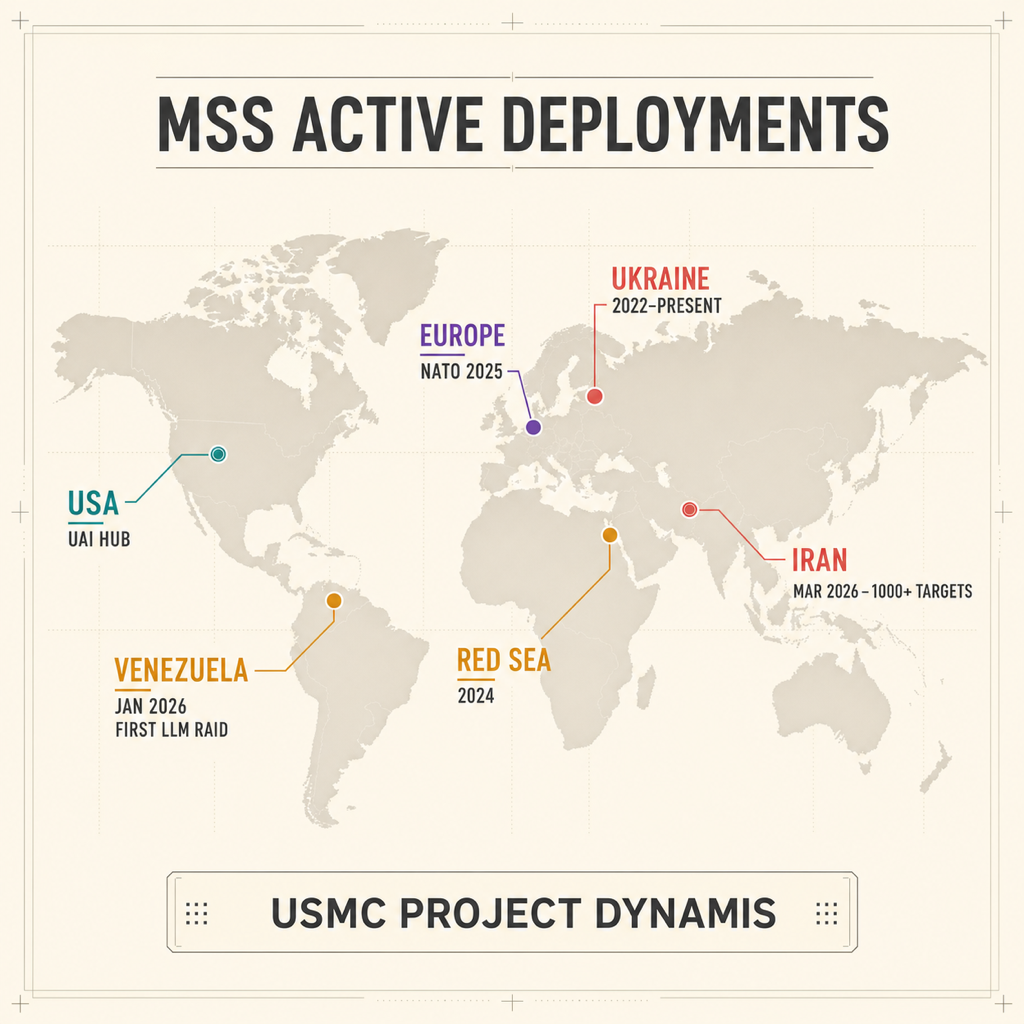
The public record is strongest on adoption and training, not live operations:
- U.S. Army exercises: Scarlet Dragon and related events used Maven-enabled imagery workflows to test faster detection, vetting, validation, and routing.
- U.S. Army training: Combined Arms Command announced in March 2026 that it was integrating MSS into command-and-control education and operator training.
- Logistics exercises: Army contracting personnel used an MSS simulation during a 2025 warfighter exercise to maintain a common operating picture.
- NATO: Allied Command Operations acquired MSS NATO in March 2025. NATO later documented training, a hackathon, and model-integration work.
- U.S. contract: The May 2024 DoD award identifies a five-year MSS production follow-on contract with work ordered as requirements emerge.
Review capacity is part of the system
The U.S. Department of Defense says AI systems should be responsible, traceable, reliable, and governable, with personnel exercising appropriate judgment and care. For high-consequence decision support, that requires visible provenance, bounded uses, realistic tests, failure detection, audit logs, and a way to disengage unexpected behaviour.
Public architecture and exercise reports omit median review time, false-positive rate, override rate, disagreement rate, and correction frequency. That omission does not prove the controls are absent. It does prevent the architecture alone from proving that oversight is adequate, obsolete, or a rubber stamp.
Treat human review as a capacity-constrained subsystem. Measure its queue and latency. Preserve source and model lineage. Separate recommendation from authorization. Log approvals, rejections, and reasons. Then test whether reviewers notice conflicts and uncertainty under realistic time pressure. Decision throughput is not a safety metric.
References
- South, T. (2024). This system may allow small Army teams to probe 1,000 targets per hour. Army Times.
- U.S. Army Field Artillery Professional Bulletin. (2024). XVIII Airborne Corps BAS-T Employment.
- Pfaff, A. C. & Hickey, J. R. (2025). Integrating Artificial Intelligence and Machine Learning Technologies into Common Operating Picture and Course of Action Development. U.S. Department of Defense.
- U.S. Army. (2025). Commander and Staff Guide to Data Literacy, No. 25-10.
- U.S. Army. (2025). Contracting personnel use AI, Maven Smart System simulation during warfighter exercise.
- U.S. Army. (2026). Army's Combined Arms Command to integrate Maven C2 smart system into training and education.
- U.S. Department of Defense. (2024). Contract W911QX-24-D-0012, Maven Smart System prototype.
- DefenseScoop. (2025). Growing demand sparks DOD to raise Palantir's Maven contract to more than $1B.
- NATO Communications and Information Agency. (2025). NATO acquires AI-enabled warfighting system.
- NATO Communications and Information Agency. (2025). NCIA participates in Warfighting Innovation Week.
- Palantir Technologies. Foundry introductory concepts: Object Layer (Ontology). Vendor documentation.
- Palantir Technologies. Apollo core overview. Vendor documentation.
- Anthropic. (2026). Where things stand with the Department of War. Company statement.
- U.S. Department of Defense. (2020). DoD adopts five principles of artificial intelligence ethics.
- U.S. Department of Defense. (2023). Directive 3000.09, Autonomy in Weapon Systems.